
Surrealism
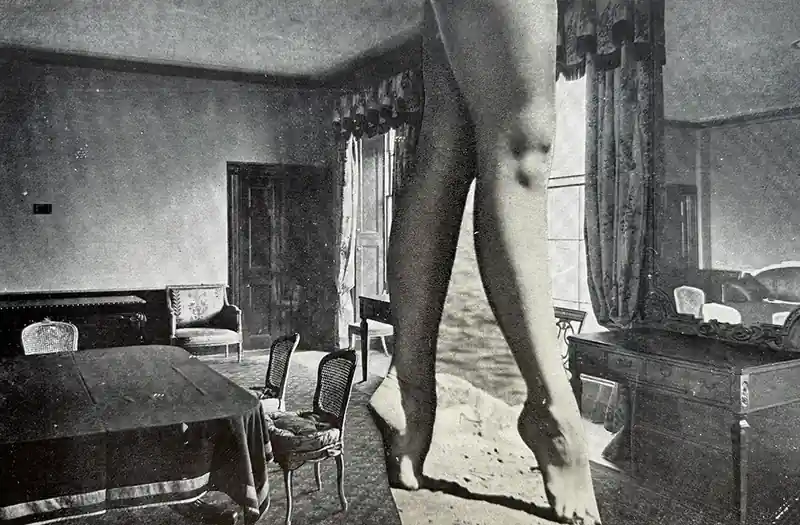
Born in the early 20th century, Surrealism is an art movement that sought to tap into the subconscious mind and bring dreamlike visions to life. Salvador Dalí’s distorted landscapes, Max Ernst’s fantastical creatures, and Yves Tanguy’s endless otherworldly horizons all pushed viewers to question the boundaries between reality and imagination.
Meet three Gamma Partner Artists who have brought Surrealism to BTC.
Milla Si
A Child of Imagination
From a young age, Milla Si was captivated by imaginary realms. Books became a portal — she would lose herself in their stories, vividly picturing herself as the heroine of fantastical adventures. These formative experiences shaped her approach to art. Today, surrealism isn’t just a style for Milla — it’s a language.
“Day by day, I fall deeper in love with surrealism,” she reflects. “For me, it’s a way to speak to the viewer through extraordinary imagery… a medium through which I channel my inner feelings, emotions, thoughts, and beliefs.” With a deep interest in spirituality and the energetic dimensions of human experience, Milla sees surrealism as the ideal form for expressing the invisible.
When asked about how she balances deliberate technique with the subconscious in her process, Milla points to intuition as the compass. She often begins with reflections on personal experiences or life events — ideas that gradually settle into her subconscious.
“During the creative process, it is my subconscious that often takes the lead,” she says. “While working, my mind transitions into a deeper, meditative state… Of course, my conscious mind still plays a role — it steps in when I need to decide how exactly to express an idea or what materials to use.” The result is a fluid collaboration between thought and instinct.
It’s no surprise that Milla’s own life and spiritual reflections fuel her creations. Every piece she makes is a fragment of her inner world, layered with emotion and meaning. One such work, Cosmic Lullaby, captures her belief in the protection and presence of higher forces.
“It evokes a feeling of boundless trust and safety,” she explains. The piece was inspired by childhood memories of being held and rocked by her mother — moments of pure peace and love. Through surreal imagery, she translates those sensations into a visual poem of divine comfort.
Symbolism is central to Milla’s practice. Human figures — representing the soul — often act as vessels for her messages. Layered with spiritual references and esoteric details, her pieces ask the viewer to look closer.
“Symbols are my primary tool for transmitting my inner knowledge and beliefs,” she shares. “Many are inspired by spiritual literature and videos that deeply resonate with me.”
Though her work feels intricate and intentional, Milla doesn’t begin with a rigid blueprint. The process is deeply intuitive. “I may start with an idea of what I want to communicate, but once I begin creating, my conscious mind nearly switches off,” she says. “I truly believe it is my soul speaking.”
For Milla, the act of creating becomes a kind of spiritual channeling — a state of harmony where inspiration and subconscious energy take over.
To bring her surreal visions to life, Milla uses photo manipulation and collage, blending sourced images with AI-generated characters. The result is otherworldly — a fusion of reality and dream. This medium, she says, offers full creative freedom.
“I’ve always found it fascinating and inspiring to see how other artists could create entirely new worlds from ordinary images,” she explains. Her technique allows her to reimagine the everyday into something infinite.
In today’s fast-paced and literal digital culture, surrealism remains timeless to Milla. “Art is eternal — regardless of its style or movement. It is constantly being reborn and evolving alongside humanity.” She believes surrealism will continue to grow, finding new forms across mediums like sculpture, film, and even architecture.
Its longevity, for Milla, stems from something essential: “Humans are intelligent, reflective beings with boundless imagination.”
Asked where she sees her work existing — within a dreamscape, a film, or an alternate reality — Milla doesn’t hesitate. “I believe any one of my works could serve as a concept or foundation for a film or an alternate reality.”
She imagines a story centered on a soul moving through stages of growth in another dimension — a narrative that blends wonder with inspiration. “I would want this story to serve as both inspiration and motivation for people — to believe in themselves, in their potential, and in their future. To love deeply, and to open their hearts to joy and harmony.”
The Symbolic Realms
Igor Martins doesn’t just create art—he explores the layered intersections of the unconscious, spirituality, and symbolism to bring surreal visions to life. For him, surrealism is not just an artistic movement but a personal and philosophical journey, shaped by therapy, mysticism, and the quiet contemplation of life’s paradoxes. His work invites viewers to look beyond the visible and into the deepest parts of the self.
Igor’s journey into surrealism began early. At just 14 years old, he encountered the work of Salvador Dalí and was immediately captivated. The themes of dreams, the unconscious, and fantastical imagery sparked something profound within him.
“I decided to become an artist when I was 14 years old and discovered surrealism,” Igor recalls. “I was fascinated by the unconscious and the world of dreams.” From there, he dove into formal training—drawing, painting, and later a visual arts degree with a focus on oil painting techniques inspired by the old masters. As he transitioned into digital art, incorporating tools like Photoshop and motion graphics, his commitment to surrealist themes only deepened.
About five years ago, Igor’s conceptual foundation expanded even further when he discovered the ideas of Carl Jung, Jungian archetypes, and mysticism. “These concepts complemented my foundation in surrealism and helped make my work more mature from a conceptual perspective,” he says.
Igor’s process is as layered as his imagery. Drawing from a decade of therapy, he developed a deep understanding of his unconscious and began to explore new ways to access it. His current practice blends traditional introspection with the analytical potential of AI—a process he refers to as augmented creation.
“I’ve been incorporating AI into my creative process… as a kind of mental prosthesis,” Igor explains. He prompts AI tools to analyze his texts and image choices through psychological frameworks—Freudian, Lacanian, Jungian—then critically reflects on the feedback. The result is a conversation between human and machine that leads him toward rich, symbolic outcomes in his artwork.
For Igor, creating is an act of healing. He draws not just from dreams or visual inspirations, but from profound inner experiences, including Christian spiritual practices like Lectio Divina, an ancient method of divine contemplation. These deep reflections stir emotions—anxiety, hope, a longing for transcendence—and often become catalysts for his art.
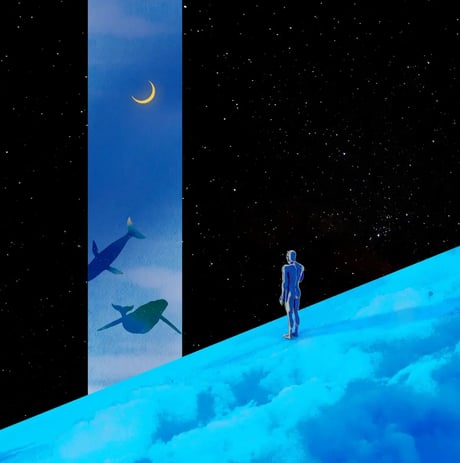
His piece Powerless emerged from a particularly dark period in his life. “I was going through an extremely difficult time… I felt completely powerless,” he recalls. The work was born from that struggle and the peace he found in surrendering to a higher power. “It was precisely in that moment that I found peace in trusting God.” The piece remains a visual expression of faith, despair, and transformation.
Surrealism thrives on paradox, and for Igor, that tension is at the heart of reality itself. “The more I recognize paradox as an essential part of the very fabric of life, the more I feel connected to reality,” he says.
He offers a symbolic view of the world: blood as both life and violence, death as both ending and rebirth, pain as a path to healing. This symbolic framework is rooted in his belief that everything is created by a higher intelligence. “Everything is a symbol. The universe itself is a message,” Igor affirms. His role as an artist is to recognize and communicate these messages visually.
Rather than starting with a clear end in mind, Igor sees art as a process of discovery. “No one has perfect clarity about what they think or do, least of all me,” he admits. Art allows him to explore his inner world and the symbolic layers of reality. Through creation, he seeks to understand himself, others, and the mystery of existence more deeply.
While Igor began with physical mediums—pencil, charcoal, pastels, oil paint—his current work is mostly digital. He now combines AI tools with post-production software like Photoshop and After Effects. This shift was partially practical, driven by time and space constraints, but his hope is to one day return to traditional painting, this time guided by concepts born from AI-generated designs.
In Igor’s eyes, surrealism is not only relevant today—it’s becoming a dominant mode of existence. “Surrealism is no longer just an artistic style,” he says. “It has become an altered state of reality.” With the rise of generative AI, deepfakes, and misinformation, the surreal bleeds into everyday life.
“I miss the time when surrealism existed in paintings, in art, and in cinema. Now, it lives in the confused minds of society.” In this context, Igor’s art offers not just aesthetic experience but a grounding in meaning—a symbolic language to navigate a shifting reality.
If Igor could place his work in any dreamscape or alternate reality, it would be as a tool for awakening. “I deeply wish to turn my art into an experience of inner transformation,” he says. His vision is contemplative, spiritual, and emotional—designed not just to be seen, but to be felt.
He hopes that by engaging with his work, people might “look within themselves, see others with more depth, and connect with the mystery of the universe and of life itself.”
In the end, Igor Martins’ art is more than surreal—it is sacred. It is an ongoing dialogue between thought and feeling, the symbolic and the spiritual, the real and the imagined. A mirror not just of the artist, but of the soul.
Inside the Dreamworlds
Muriel Lherm’s work doesn’t just depict the surreal — it lives in it. Her art floats in that liminal space between the subconscious and the digital, between memory and machine. Using AI as both mirror and collaborator, Muriel constructs dreamlike environments rich with ambiguity, emotional resonance, and quiet symbolism. For her, surrealism isn’t a technique. It’s a language.
Even before she began making art, surrealism was already embedded in Muriel’s world. “I’ve always been drawn to surrealism, it’s been a constant presence in my life,” she shares. The movement’s ability to distort reality and time, to express emotional truths through dream logic, captivated her from the start.
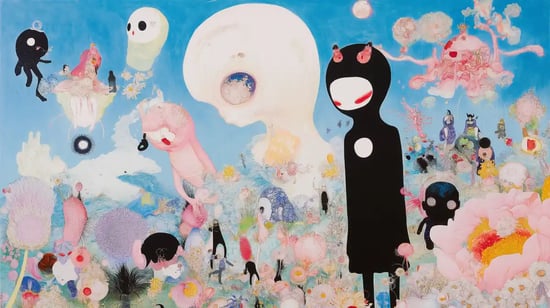
Her early artistic worldview was deeply shaped by the Superflat movement and its founder, Takashi Murakami. Artists from his collective — especially Aya Takano, Chiho Aoshima, and Ai Yamaguchi — introduced her to a vision of surrealism that was luminous, poetic, and unapologetically feminine. “Each of them showed me how surrealism could be luminous, tender, and profoundly feminine,” Muriel reflects.
Over time, her relationship with surrealism evolved from admiration to authorship. With the rise of AI tools, she began creating immersive inner landscapes where memory, intuition, and emotion converge. “Surrealism became more than just an influence, it became my language.”
Muriel’s process is uniquely collaborative — not just with herself, but with the AI she uses as a creative partner. “I never fully control the outcome, nor do I want to,” she explains. She begins not with a strict concept, but with a mood or visual intuition. The AI’s response often surprises her, reflecting back subconscious fragments she wasn’t consciously aware of.
“I don’t see the AI as a tool I direct, but more as a collaborator,” she says. Her role is to shape and refine — to respond to the unexpected rather than overwrite it. This process of co-creation is where her surrealism finds its form: not in rigid plans, but in the evolving conversation between intention and accident.
Though often abstract or otherworldly, Muriel’s work is deeply personal. Dreams, memories, and lived experiences quietly shape her visual narratives — sometimes without her even realizing it until after a piece is finished.
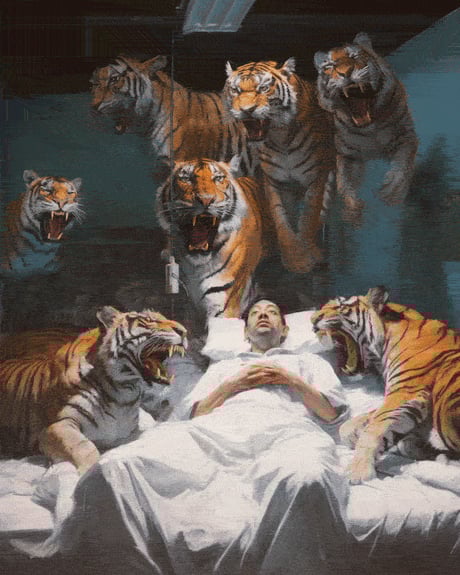
One work, Echoes of Learning, appears on the surface as a surreal animation of children returning to school. But underneath lies a tapestry of memory: her children’s first days at school, and the presence of her grandfather, a teacher. Beethoven’s Appassionata, a piece he once played, became the soundtrack — unplanned, but perfect. “It added a quiet emotional weight to the work… as if fragments of memory and feeling had arranged themselves without my full awareness,” she recalls. “That’s the beauty of working with AI, it helps surface what’s hidden inside.”
For Muriel, symbolism is not about fixed meanings. It’s about emotional triggers — open-ended cues that awaken a sense of recognition in the viewer. “Eyes, altars, stairs, floating figures… they carry emotional or psychological weight that I return to again and again,” she notes.
Rather than dilute her control, AI tools help her test, refine, and arrange these visual metaphors with greater nuance. The result is a symbolic language that’s deeply personal yet universally evocative — symbols as catalysts for reflection, memory, and mystery. “I want viewers to recognize something in the work, even if they don’t know why.”
Muriel rarely starts with a fixed vision. Her process begins with a feeling — a tension or emotional tone — and unfolds from there. “Working with AI allows for that kind of openness,” she says. As the piece evolves, her sense of composition, color, and metaphor sharpens the direction.
“It’s a dance between intuition and precision, where each step informs the next,” she explains. The most resonant works, she says, emerge from trusting that process — allowing space for accidents and shaping them into emotionally truthful expressions.
To bring her visions to life, Muriel combines a range of tools: MidJourney for visuals, Runway and Hailo.ai for animation, CapCut for timing, Ideogram for text-based visuals, and Suno.ai and ElevenLabs for music and narration. As part of the Adobe Creative Community Program, she also uses Firefly and Photoshop for evolving and refining her work.
“This digital ecosystem gives me precision without limiting spontaneity,” she explains. The interplay between control and accident is where her surrealism lives — a place where emotion and technology breathe together, where what’s imagined and what’s real blur into a single image.
In a world defined by clarity, speed, and optimization, Muriel sees surrealism as a necessary emotional counterbalance. “Surrealism resonates today because it offers what so much of the digital world lacks — ambiguity, emotion, and mystery,” she says.
Historically born from a need to push back against rationalism and upheaval, surrealism is, for her, just as relevant today — if not more. “In a world saturated with surface images and instant answers, surrealism helps us reconnect with depth, uncertainty, and meaning.”
If she could place her art in a movie, dream, or alternate reality, Muriel imagines a vast immersive world — “part museum, part mirage.” A place built from memory fragments and emotional echoes. Inspired by the dreamlike emotion of Tarkovsky’s The Mirror, the data fluidity of Refik Anadol, and the poetic futurism of Claire Silver, she sees her work not as static imagery, but as living environments for reflection and feeling.
“I don’t see my work as static, it’s always in motion, always between states,” she says. “Placing it in a dreamscape allows it to breathe — to become not just something to look at, but something to feel, explore, and remember.”
In that dreamspace, Muriel Lherm’s surrealism truly comes alive — mysterious yet familiar, ephemeral yet full of truth. An emotional map for those willing to follow it.