
Artists have long used money itself as a medium to question value, from Cildo Meireles’ Banknote Project where political messages were stamped onto circulating bills to J.S.G. Boggs’ hand drawn “counterfeit” notes that invited debate over what money really represents.
From projects such as Cents by Rutherford Chang, to artists including Sir Gadfly, Alejandro Peters and FIATFIRE who are all bringing this concept to BTC, placing FIAT against Bitcoin’s permanence, these artists reveal how value shifts, erodes, and endures far beyond the promises printed on a note or a coin.
For Sir Gadfly, fiat money has always been the perfect villain. “It’s paper chains dressed up as wealth, fragile, inflated, and controlled by a few hands at the expense of everyone else,” he says. His Fiat Prison series was born from that realization: “we’re living in cages built from promises that keep devaluing. Even my Bill of FUD artwork… and Sacrifice… all echo the disastrous themes of FIAT. Bitcoin, by contrast, is truth carved into code, immutable, scarce, sovereign. My art lives in that tension: exposing the lies of fiat while celebrating the freedom of Bitcoin. One is a prison; the other is the key.”
That tension drives every piece. Sir Gadfly watches people not just lose money, but lose faith, faith in promises like this fiat will hold value, this system cares about you, this future is stable. “Bill of FUD exposes that rot,” he explains. “It’s the fear, uncertainty, doubt baked into the system: ads promising value, leaders promising stability, and behind the curtain inflation, currency devaluation, runaway money printing. It’s the heartbreak of trusting something that’s structurally rigged to betray you. In Sacrifice, I focus on what people have to give up, dignity, autonomy, future opportunity, just to survive under broken monetary regimes. What you sacrifice when your currency fails: savings disappearing, wages falling behind, hope getting taxed away. Visually & emotionally, I want the viewer to feel a rising panic: that creeping edge when money in your hand means less every day. I use distortion, decay, jagged edges, and intrusive layers to mimic hyperinflation, to simulate watching wealth slip through fingers. Then Bitcoin enters as counterpoint: not perfect, but at least predictable, at least scarce. In each piece, Bill of FUD especially, there’s an implied escape pod: a way out of the collapse. The more visceral the collapse feels, the more powerful the pull toward sovereignty becomes.”
Much of his imagery draws from the very symbols fiat uses to project power. “In Sacrifice, I take Benjamin Franklin’s face, a symbol of American identity, power, and even virtue, and set it against the image of burning money. That clash is the schism: the nation’s ‘founding wisdom’ burning under the weight of its own currency system. In Tax Me to Death, the hand burns while ‘Uncle Scam’ looms, the patriotic mask over predatory control. These works recycle the very symbols fiat uses to claim legitimacy and twist them back on themselves. I want viewers to feel that tension: the authority of fiat imagery collapsing into distortion and fire, while Bitcoin hums beneath as the counterweight. My art constantly pushes that boundary, taking the icons meant to unify and exposing their fragility. That contrast, that recycled symbolism, is how I show the break between fiat’s mythology and Bitcoin’s truth.”
Scarcity versus excess also plays a central role. “With Bill of FUD, I stamped in the line ‘Halving the Last Laugh,’ a nod to Bitcoin’s halving cycles. Every time fiat overextends itself, Bitcoin answers by tightening. That rhythm is comedy to me: the joke is always on the system that thought it could print forever. I show excess with saturation and clutter, but I don’t drown the canvas. My style leans toward minimalism, one bold figure, one burning hand, one distorted face. Then I fracture it with glitch, to inject the instability and energy of the real world. That’s the contrast: minimal form, maximal distortion. Scarcity in the bones, chaos in the skin. It’s my way of showing that Bitcoin is clean and finite, while fiat is infinite but falling apart, and in the end, it’s Bitcoin that gets the last laugh.”
Inflation, often called a hidden tax, becomes visceral in his work. “Inflation is theft dressed as policy, the ‘hidden tax.’ I show that erosion not by painting a tax form, but by making value literally melt away on the canvas. In Tax Me to Death, the burning hand is that invisible theft made visible: wealth slipping through your fingers no matter how tightly you hold on. I lean on glitch and decay, fragments dissolving, faces breaking apart, images collapsing into static. It’s visual erosion, the slow grind of savings losing meaning. The viewer feels the loss in the image itself: nothing stays whole, nothing holds still. That’s the hidden tax brought to light. You can’t see it when numbers on paper look stable, but in my work, you can feel it in your gut.”
He believes art can stir emotions in ways numbers never could. “Art can go where numbers can’t. Fiat Prison is my clearest example. It’s a diptych, Obey and Burn, built as a 3D lenticular so the viewer doesn’t just see inflation, they step inside it. The depth pulls you through the Matrix itself: first into Obey, where Templar Knights, dragons, and symbols of control trap you in the system’s cage. Then, as you move, you break through into Burn, the prison collapsing, the fiat world decaying, fire swallowing the old order. Numbers can’t make you feel trapped. Headlines won’t make you feel the walls closing in. But standing in front of Fiat Prison, you feel that tension physically, the shift, the distortion, the decay. That’s how art makes inflation visceral: it becomes a prison you can sense, and a fire you can’t ignore.”
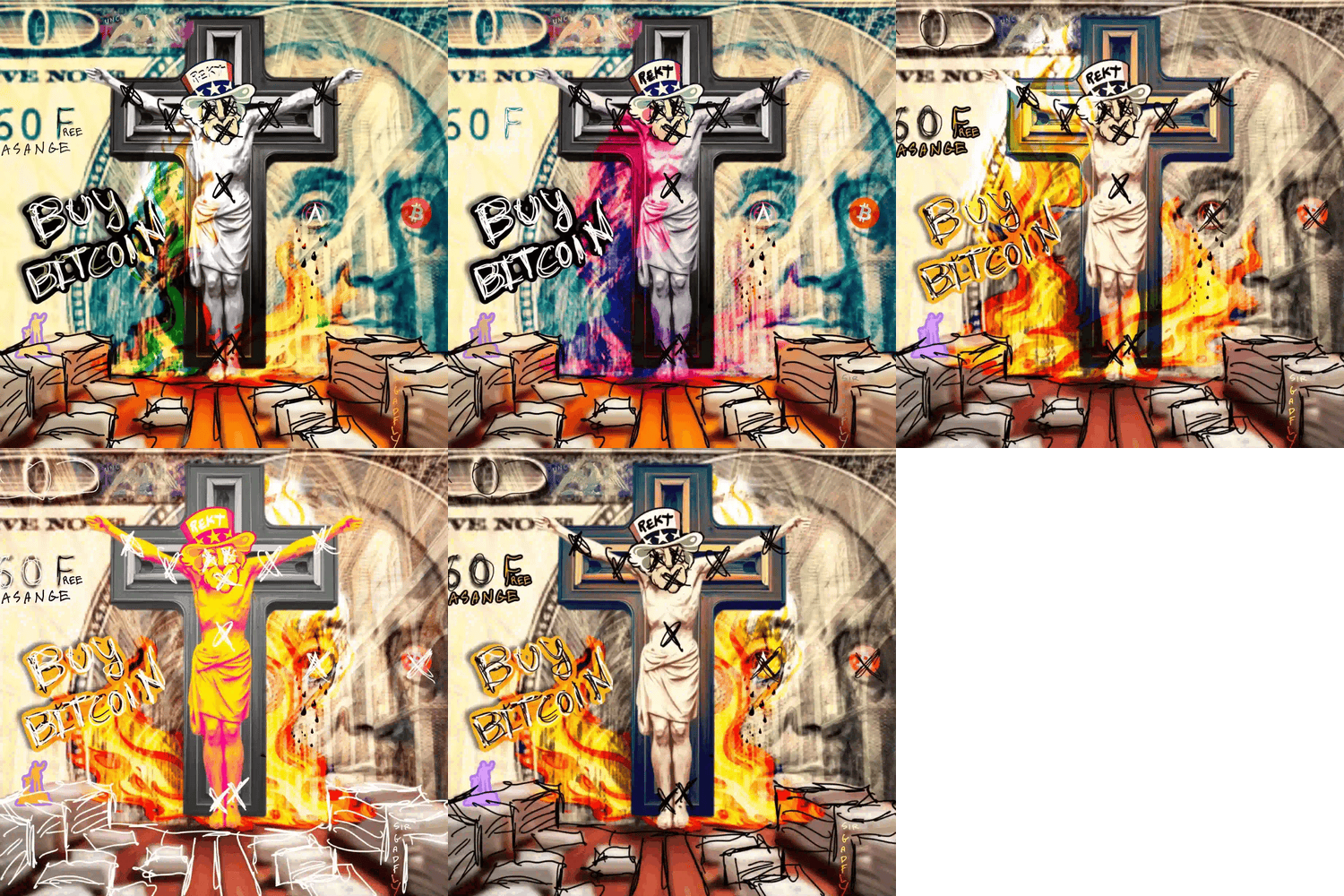
Every piece serves as both critique and bridge. “I see my work as both critique and bridge. In Firestarter, the matchstick morphs into a butterfly, Bitcoin’s metamorphosis from fragile spark to unstoppable force. In my Revolution Clock, time itself becomes the message: Bitcoin doesn’t age, it stays in cadence with the future. In Burn, the San Francisco bridge collapses as the city falls, yet the anonymous rise from the ashes, a bridge destroyed, but a new one built through Bitcoin. I weave bridges everywhere, literally and symbolically. Hope, privacy, freedom, even in my piece with the glitched cross and coded hand-drawn messaging, it’s a resurrection narrative pointing back to the same truth: buy Bitcoin. In Tax Me to Death, with Uncle Scam looming, it’s the same refrain. The echo is intentional. Fiat decays, but Bitcoin remains. Every piece I create critiques the lie, warns of collapse, and then offers that bridge toward sovereignty, the recurring signal: buy Bitcoin.”
The histories of countries like Venezuela, Argentina, and Zimbabwe also weigh heavily in his work. “The histories of Venezuela, Argentina, and Zimbabwe show what happens when fiat collapses in fast-forward: families stripped of savings, paper promises turning to dust. I reflect that collapse in my art through glitch, burn, and decay, faces dissolving, hands on fire, symbols of authority breaking apart. It’s the chaos of hyperinflation made visible. But it’s not just history. Having just traveled to Japan and Hong Kong for Bitcoin Asia, I’ve seen how fragile money feels in regions living under constant geopolitical tension. Taiwan exists today because people once fled China with nothing but what they could carry. You can’t run with your house, or 100 gold bars, or cupboards of jewels. But you can carry Bitcoin. That’s already happening, wealth leaving China, landing in Hong Kong or Taiwan, secured by private keys, not paper. So when I create Sacrifice, Tax Me to Death, or Fiat Prison, I’m not just drawing on past hyperinflations. I’m echoing the present: people all over the world hedging with Bitcoin because they know the story always repeats. My art archives those collapses, warns of what’s next, and shows Bitcoin as the one vehicle you can trust to carry wealth across borders and through time.”
His decision to inscribe these works on Bitcoin itself is both symbolic and strategic. “Yes, it’s absolutely symbolic, but it’s also intentional to the point of obsession. I don’t just inscribe anywhere. I’ve focused my work on historically significant blocks: Block 9s 450Xs, Block 78s, Block 286. Recently I’ve been collecting and inscribing on Block 666, and I just picked up 100,000 sats from Block 419, the only one of its kind. For me, the canvas matters as much as the image. Bitcoin is the ultimate canvas. It’s more expensive to inscribe, but that’s the point: permanence carries weight. When my work lives on Bitcoin, it lives across millions of nodes. It’s immutable. It’s forever. That stands in direct contrast to NFTs on IPFS, if someone stops paying the bill, they vanish into a 404. So yes, the choice is symbolic, but it’s also deeply strategic. I’m not only making art about Bitcoin, I’m inscribing into its earliest layers of history. My work critiques fiat’s impermanence by living on Bitcoin’s permanence. That’s the difference between fragile propaganda and indestructible truth.”
Ultimately, Sir Gadfly sees his art as both documentation and warning. “For me, inscribing art on Bitcoin is about capturing history in real time. Whether it’s a piece like Fiat Prison, or even something timely like Trump’s mugshot, it’s all part of documenting the cultural moment. I want people, my kids, my grandkids, and future generations, to look back and know that Sir Gadfly left a lasting impression. You don’t frame a $1,000 bill and hang it on the wall, that’s fragile, fleeting. But you can hang Bitcoin art. That’s the ultimate flex across time: something permanent, immutable, and woven into the very fabric of the hardest money ever created. My work doesn’t just critique or celebrate, it archives. It ensures that when fiat fades into history, the art and the message live forever on Bitcoin.”
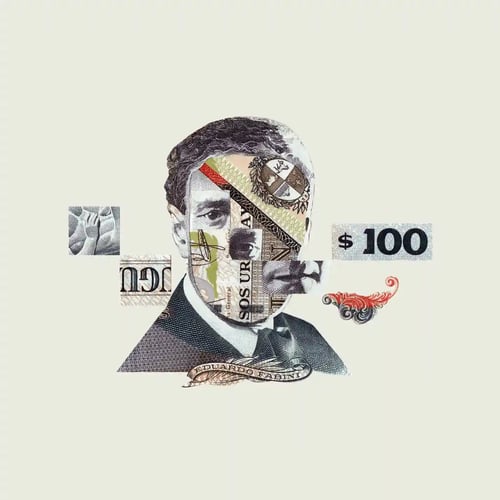
Alejandro Peters creates art that questions the meaning of money while celebrating the possibilities of Bitcoin. He has always been fascinated by the symbolic weight of currency and how a simple piece of paper can hold value because people collectively believe it does. Through his collage work he explores what happens when a banknote is cut, transformed, and given a new purpose. Rather than losing value, he believes it gains a new one. For Alejandro the process is not about destroying money but about reimagining its purpose. That exploration of value naturally led him to Bitcoin, a decentralized and borderless system that aligns with the way he sees the future of both money and creative expression.
Using money in art is not a new idea, and Alejandro recalls seeing a powerful ad campaign years ago that used banknotes to make a statement. Although that campaign was not his direct inspiration, it left a lasting impression. He approaches his work without the intention to provoke. Instead of destroying value he repurposes it, treating each bill as another piece of paper that carries weight, history, and meaning. Working with real currency, especially from countries other than his own, introduces a sense of scarcity and pressure. Often he only has a single bill to work with, leaving no room for mistakes. That limitation makes his process deliberate and careful. It is less about criticizing broken systems and more about transforming what we have into something meaningful.
Each fiat bill carries cultural weight through its faces, symbols, and national stories. By bringing fiat money into conversation with Bitcoin and inscribing it permanently on the Bitcoin network, Alejandro sees his work as a way to preserve history. What was once analog and physical now lives permanently on chain, reimagined, reinterpreted, but never erased. For him this is not about tension but about transition. It is a movement from hand to data, from value to meaning, from local history to global memory.
Scarcity is an essential part of his practice. He often works with a single banknote, one chance and one composition, where every cut must count just like each satoshi in Bitcoin. While fiat can be printed endlessly, his process is intentional, finite, and irreversible. He turns what is mass produced into something unique, a quiet reminder that true value comes not from excess but from meaning.
Alejandro also reflects on the fragility of currency in the face of inflation. When he cuts into a bill he is not trying to ruin it but to reveal what is slipping away. A banknote is meant to feel solid and trustworthy, yet inflation erodes that trust quietly and invisibly. Through collage he exposes that fragility. Art, he believes, makes people feel the effects of inflation in a way numbers and headlines cannot. Seeing a real banknote cut, fragmented, and reassembled allows viewers to feel the loss and to notice what is missing.
Despite the themes of inflation and scarcity, Alejandro does not see his work as a critique of fiat or a warning about the future. He is not interested in declaring fiat broken or Bitcoin as salvation. Instead he explores how something trusted like a bill can be cut, transformed, and still carry meaning. He hopes his work feels like a bridge from physical to digital, from tradition to possibility, from what society has always believed to what it is starting to imagine.
Although countries such as Venezuela, Argentina, and Zimbabwe have faced hyperinflation, Alejandro explains that his use of currency is not rooted in those histories or political statements. His intention is to treat each bill with care, knowing that for someone that currency may once have meant food, safety, or freedom.
Inscribing his work on Bitcoin felt like closing one chapter and opening another. Once a bill is transformed into art it is no longer just currency. It becomes memory, symbol, and art, living forever on a system built to resist decay. For Alejandro this is not about celebrating the fall of fiat but about celebrating Bitcoin as a canvas for transformation. His work is not an act of destruction but a documentation of value evolving.
FIATFIRE creates art that confronts the fragility of money and the global systems that sustain it. His work emerged from a convergence of influences, beginning with an understanding of the connection between fiat currency, U.S. global hegemony, and the military industrial complex, particularly in the aftermath of the Iraq and Afghanistan wars. Around the same time, he discovered the work of J.S.G. Boggs, the monetary artist known for hand drawn hyper realistic “counterfeit” bills that he would attempt to use as real money. Boggs invited people into a conversation about what money is and is even considered by some to be a philosophical predecessor to Bitcoin. FIATFIRE later learned that Boggs advised early thinkers interested in electronic cash systems in the 1990s. When he first encountered the Bitcoin white paper he thought it was a clever idea but believed the government would never allow anything that might threaten the dollar’s role as the global reserve currency. Over time he began to see fiat’s collapse and the adoption of Bitcoin as inevitable, and creating art about this shift became a natural extension of those ideas.
He notes that while the consequences of fiat failure are often more severe outside the United States, discussions about inflation tend to center disproportionately on the U.S., which he finds almost embarrassing. Countries like Zimbabwe and Venezuela are well known examples, but he points to widespread currency crises across the world, from the post Soviet economies of the 1990s to parts of Africa using the Central African franc and to Lebanon. Recently he has begun incorporating currencies such as the Mongolian togrog from 1993, the Ukrainian hryvnia from 2014, and the Korean won from 1953. Bitcoin is a global phenomenon, and he believes it is important to better represent the realities of currency collapse everywhere.
For FIATFIRE, fiat currency is less about patriotism than about trust, convincing people to believe in paper. That trust is embodied in engraved portraits of national heroes who are calm, composed, and dignified. Figures such as Simón Bolívar or Abraham Lincoln are meant to symbolize stability and unity. His art explores what happens when these revered icons become the faces of systems unraveling. He points to Lincoln, whose legacy is tied to preserving the Union, yet whose image circulates on currency that funds wars, fuels division, and props up a debt ridden fiat system he never could have imagined.
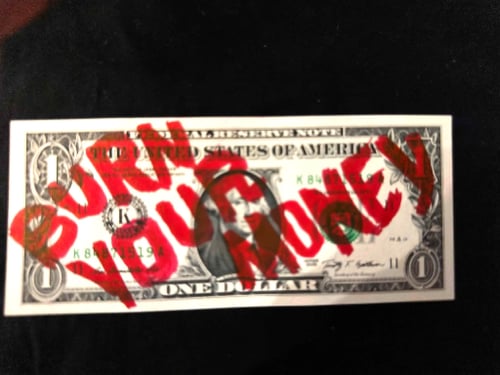
Scarcity plays a central role in his process. Rather than relying on overused imagery like burning money in stock footage or memes, he works only with real, physical currency, each note carrying a unique serial number and a lived history. Every piece is inherently one of one, a kind of numbered limited edition by default. To push scarcity even further, he sometimes uses uncut sheets and packs of uncirculated notes. In his Burn Your Money series he works with a run of uncirculated bills numbered one through one hundred, each paired with a matching inscription on a specific satoshi. This creates scarcity not only in the physical world but also digitally, anchoring the work to Bitcoin’s fixed supply and creating what he calls a dual chain provenance, the fragile nonsense of fiat ephemera secured by immutable code.
The act of burning currency visualizes the hidden tax of inflation. FIATFIRE describes it as a funeral rite, a finality where value curls into ashes. It represents not just lost purchasing power but the evaporation of time and effort, the work and sweat that the currency once stood for. Sitting next to the fire, spraying a note with lighter fluid, he feels a mix of revenge, catharsis, sadness, excitement, and incitement.
Art, he believes, can make people feel the effects of inflation in ways that numbers and headlines cannot. Most people will not read books like Lyn Alden’s Broken Money or Adam Fergusson’s When Money Dies, or even the newspaper article embedded in Bitcoin’s genesis block. Life continues as if the system is natural until something nudges people to question it, and art can be that nudge.
Although FIATFIRE has gone all in on Bitcoin in his personal life, he never refers to it directly in his art. He wants the critique of fiat to speak for itself and to spark curiosity without feeling like an advertisement. His goal is to bring viewers to the portal of understanding more quickly than his own journey took. If they choose to take the orange pill and go deeper, the art becomes far more valuable than anything they could have paid for it.
Research is a key part of his process. He studies not only inflation rates at the time of a currency’s minting but also the histories and figures depicted on the notes. Holding a circulated Reichsmark from the 1920s, for example, he feels the weight of its past, imagining it once destined to buy a loaf of bread before becoming worthless, perhaps one of the bills pushed in a wheelbarrow to a grocery store. He has used Venezuelan bolivares in several works and notes the strange contrast of their aesthetic beauty and practical worthlessness.
The decision to inscribe his work on Bitcoin adds another layer of meaning. Ideally, he says, he would do everything on Bitcoin, because the tension between fragile paper and permanent digital records captures the transformation he seeks to preserve. One day he hopes to burn very rare currency to show that the project is not about fetishizing fiat but about documenting the fleeting years when everything shifted. He admires projects like Rutherford Chang’s CENTS collection, which captures a moment just before pennies were phased out and recognizes the significance of preserving these transitions before governments and markets move on.
For FIATFIRE the art lives somewhere between documenting the fall of fiat and giving an unspoken nod to Bitcoin. It is explicitly a critique of fiat and all its machinations, but it also quietly celebrates the possibilities of a new system waiting to replace it.
.png)