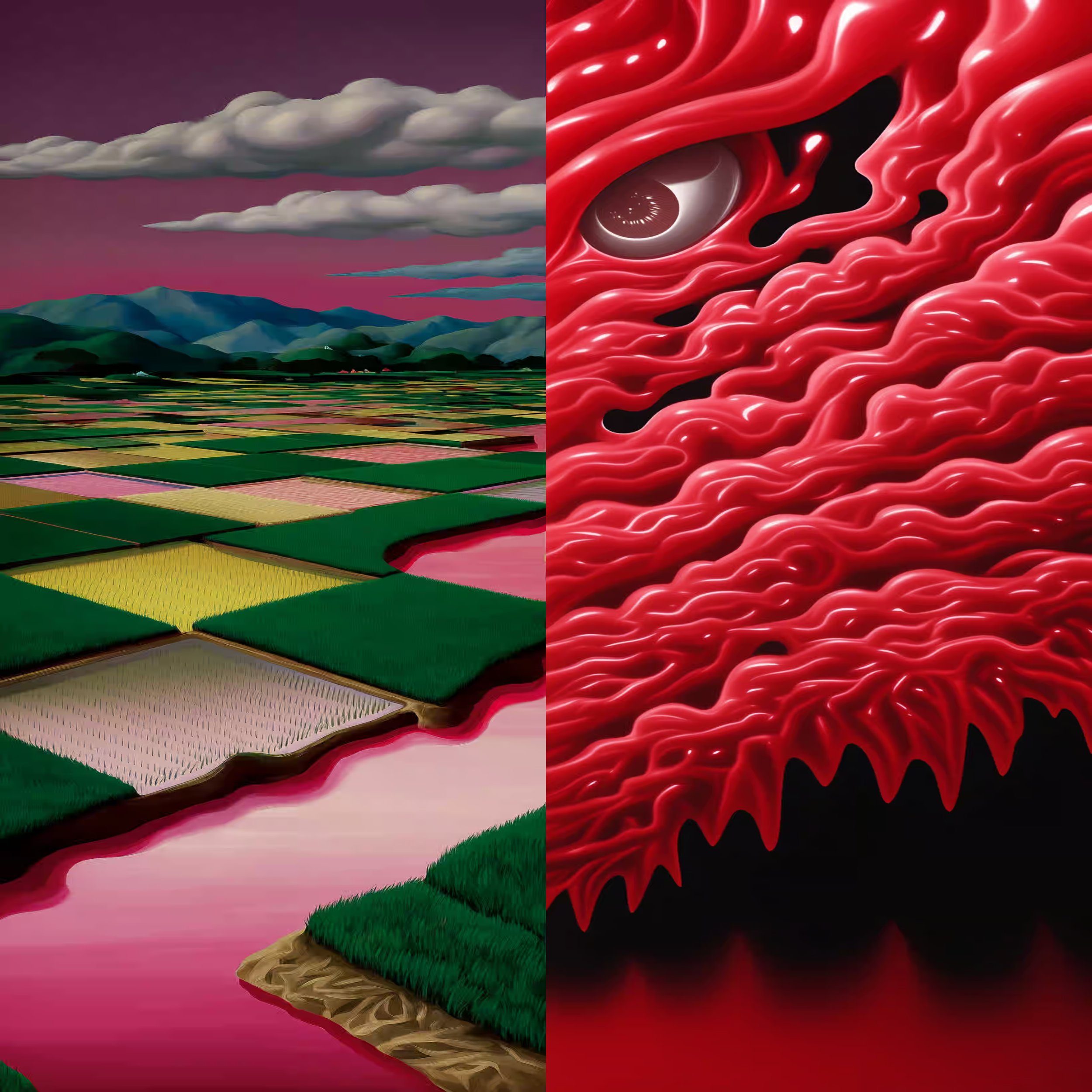

Landscapes became the medium of choice because they allow division to exist without becoming immediately psychological. A portrait carries identity on its surface through expression, intention, and emotion, whereas a landscape holds meaning more quietly through layers, atmosphere, and memory. In CLEAVE, the act of splitting is structural rather than emotional. Landscapes endure the cut, giving fractures an architectural, almost geological weight. This approach allowed RedruM to introduce a series that feels fresh by mutating traditional aesthetics while preserving the emotional and conceptual tension central to his work.
CLEAVE consists of 64 permutations created recursively from eight original landscapes split in half. For RedruM, the creation process was as important as the outcome. Working with Gamma allowed CLEAVE to function as a system rather than a fixed set of images. By defining a structure and allowing recombination to take over, each permutation emerges as a distinct state of the same idea rather than a simple variation.
A central theme in CLEAVE is the memory of what it once connected, which manifests visually in the tension between continuity and mismatch. When two halves recombine, lines, light, or atmosphere occasionally align, evoking the sense that they once belonged together even when they clearly do not. Using a shared visual language including consistent palettes, depth, and environmental textures, each fragment retains a sense of origin. The result is a quiet echo of the original whole rather than a forced resolution.
The title CLEAVE embodies duality, holding two opposing actions at once: to split and to bind. Across the permutations, identity shifts dynamically. In some configurations, proximity turns difference into continuity, forming new coherence, while in others, collision exposes fractures and emphasizes separation. The meaning of cleave changes from one permutation to another. Sometimes identity emerges through fusion, other times through contrast. Neither state is definitive, each is a temporary condition shaped by the interaction of parts.
This concept of dual becoming, where the severed becomes whole again, ties into broader themes in RedruM’s work. Throughout his practice, duality, good and evil, light and shadow, has never been about opposition but coexistence. In CLEAVE, severed elements do not resolve by choosing one side, but by allowing both to remain present in a new configuration. This resonates strongly with digital art on the blockchain, where nothing is ever truly erased. Fragments persist, are recombined, and continue to exist in parallel. Wholeness becomes about holding contradiction without collapsing it.
For collectors and viewers, minting CLEAVE is less about acquiring an image and more about inhabiting a moment of tension or balance. Each permutation represents a state where rupture and resonance coexist. By minting, collectors align with a specific instability, choosing how they engage with the fracture.
Looking ahead, the project reinforces that division does not have to imply loss. By working with fragmentation, systems, and recombination, RedruM discovered new ways of generating meaning without resolving tension or forcing unity. What surprised him most was how emotionally legible the system became. Even without a central human figure, the permutations carry presence, memory, and imbalance, qualities central to his practice. CLEAVE demonstrated that structure itself can carry narrative and that instability can be a space to inhabit rather than something to fix, offering a new dimension for RedruM’s ongoing exploration of identity and meaning.