Meet Murat
Meet Murat Atimtay, whose artistic journey began with a firm decision after high school: to make a living from art. In 2001, he entered the world of tattooing through an apprenticeship that would shape his creative foundation. Over time, he developed a unique style called Heliantone, blending tattoo artistry with creative coding. This fusion has awards across European conventions. His interest in programming deepened during the pandemic, leading him to the world of NFTs. He released work on Ethereum and Tezos, but it was his generative collection Blueprints that brought him to Bitcoin. Released on January 3rd, the anniversary of Bitcoin’s Genesis Block, Blueprints sold out in under five minutes. The Ordinals community, he recalls, welcomed him warmly.
Structure and Surpise
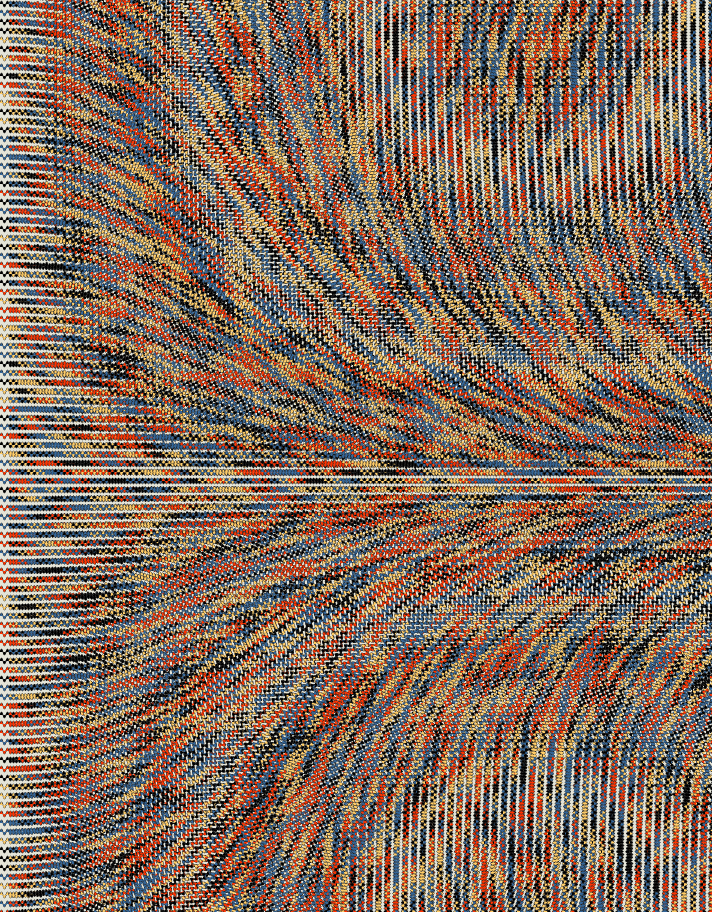
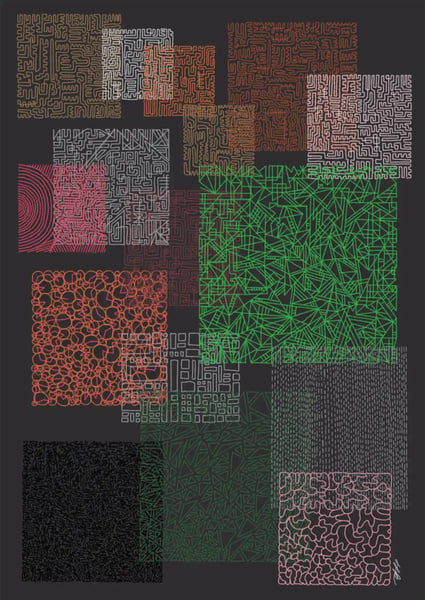
Atimtay describes himself as an experimentalist who thrives on the intersection of structure and surprise. His generative systems are inspired by a wide array of disciplines: math, architecture, physics, nature, even spirituality. He builds coded frameworks that explore symmetry, recursion, and randomness, giving rise to pieces that evoke blueprints, digital ruins, or pulsating organic flows. His process is iterative and intuitive, often revisiting old ideas or blending abandoned ones to spark new directions. The recent introduction of pen plotters has added a tactile element to his art, allowing him to watch algorithms take physical form on paper. For Atimtay, authenticity stems from building logic-based systems that can surprise even their own creator.
Permanence
The decision to release art via Bitcoin Ordinals was driven by one powerful idea: permanence. “There’s something poetic about inscribing generative art directly onto the most secure and decentralized ledger we have,” he explains. The limitations of the Bitcoin protocol actually sharpened his artistic process. “You’re forced to distill your work to its essence... There’s no room for excess, and I love that constraint.” He notes that collectors on Bitcoin often prioritize provenance, minimalism, and permanence—values that align with his own system-driven and intentional approach.
Blueprints and Pulseforms
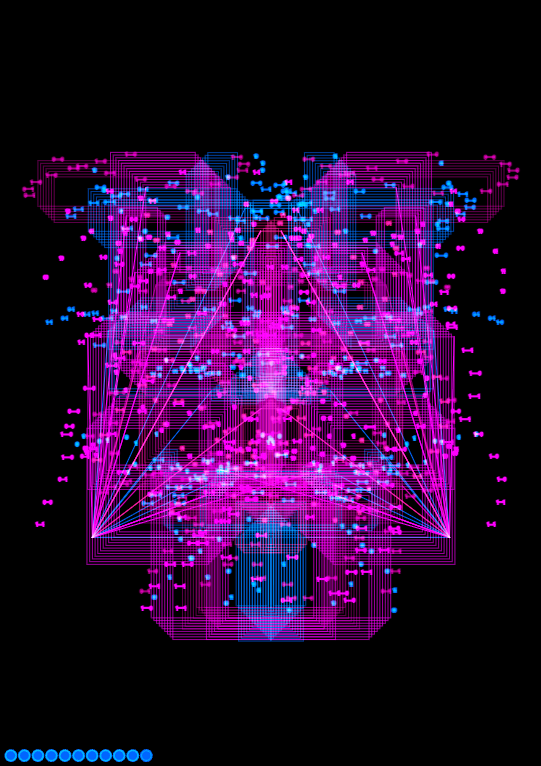
Atimtay’s debut collection, Blueprints, was a minimalist generative series inspired by architecture and early computer artists like Vera Molnar and Herbert W. Franke. Built from just three elements: rectangles, lines, and symmetry. This took nearly a year to finalize. The breakthrough came when he introduced subtle imperfections, disrupting the balance just enough to add tension.
His second Ordinals project, Pulseforms, shares some technical DNA with Blueprints but explores entirely different territory. Each Pulseform is inscribed with a lifespan (1,024 to 4,096 blocks) and evolves over time on-chain. It behaves like a living entity, emitting a digital chant that, while not traditionally pleasant, becomes strangely hypnotic. This work marked Atimtay’s dive into what he calls technomancy, the mystical energy that arises when code begins to feel alive.
Code to Plotter
Though self-taught, Atimtay has a strong background in traditional art, having explored oil painting, watercolor, and tattooing. Yet, it wasn’t until he embraced generative code that he truly felt inspired. Code opened a new realm—where logic meets chance, and the artist becomes a builder of systems. Rather than producing a single piece, Atimtay now designs entire ecosystems, shifting between the physical and digital worlds to keep his process vibrant.
Let Go
This artistic evolution has shaped Atimtay beyond his work. He’s learned to be patient, to embrace uncertainty, and to allow creative processes to unfold naturally. "Sometimes the best ideas come from letting go of control," he reflects. Stepping away from unfinished work and returning with fresh eyes has become a vital part of his rhythm. He also emphasizes that art isn’t a race. “We all have our own unique path… the key is to keep improving at a pace that feels right.”
Let Ideas Evolve
Atimtay credits the early pioneers of generative art—Vera Molnar, Manfred Mohr, Georg Nees, Frieder Nake, and A. Michael Noll as central influences. But when it comes to inspiration, he doesn't begin with reference points. Instead, he lets ideas surface during the process itself, trusting his intuition to reinterpret what resonates and mold it into something new. Originality, he believes, comes from letting ideas evolve and trusting that their voice will emerge over time.
Slow Down
The technical, communicative, and emotional demands of working in a rapidly evolving digital space pushed Atimtay to adapt. One of the biggest lessons came through Blueprints. It wasn’t technical difficulty that delayed the launch, but rather his own intuition telling him the piece wasn’t ready. Learning to listen to that voice, and resisting the rush of the crypto cycle, became key. “Slowing down and honoring the natural rhythm of my creative process has been one of the most valuable lessons.”
Keep Experimenting
For the future, Atimtay aims to push deeper into what’s possible with Bitcoin Ordinals. He’s interested in creating evolving, modular works that are native to the Bitcoin protocol and collaborating with like-minded artists. As always, his goal is to keep experimenting and to let the medium guide the message.
Authenticity Over Speed
His advice for new digital artists in crypto? “Take your time.” Atimtay urges artists to prioritize authenticity over speed, to learn the mechanics of the tools they’re using, and to stay curious. “This space rewards exploration,” he says. “And connecting with others, sharing knowledge, and collaborating is one of the best parts of being here.”