

Noema
Noema explores the intentional content of consciousness, the lived version of experience rather than the object itself. When beginning this series, Pawel Dudko approached the work with a desire not to rush the process, letting perception and thought unfold gradually. He reflects on how this shaped the early development of the series.
He explains that the creative process itself was not radically different from his usual approach. What changed with Noema was the decision to let certain pieces simply exist for a while. He did not share them or publish them. He just experienced them and then set them aside.
That choice had a profound effect on how the works evolved. When you step away from an image long enough, the memory of it begins to fade. What remains is a kind of distilled afterimage, the essence of what mattered, not the full, detailed record. The mind keeps only the essential structure.
And sometimes, when you return to the piece after weeks or months, it genuinely surprises you. It is no longer what you remembered. It is different, almost foreign. Our memory can mislead us in wonderful ways, because the gap between what was and what we recall creates room for a new encounter.
Coming back to the work in that state feels almost like looking at someone else's image. It allows him to be more objective, more critical, and more attentive to what the piece actually is, not what he thought it was. That distance created purely by time became one of the foundations of Noema.
Exhibited with Suburbs Gallery
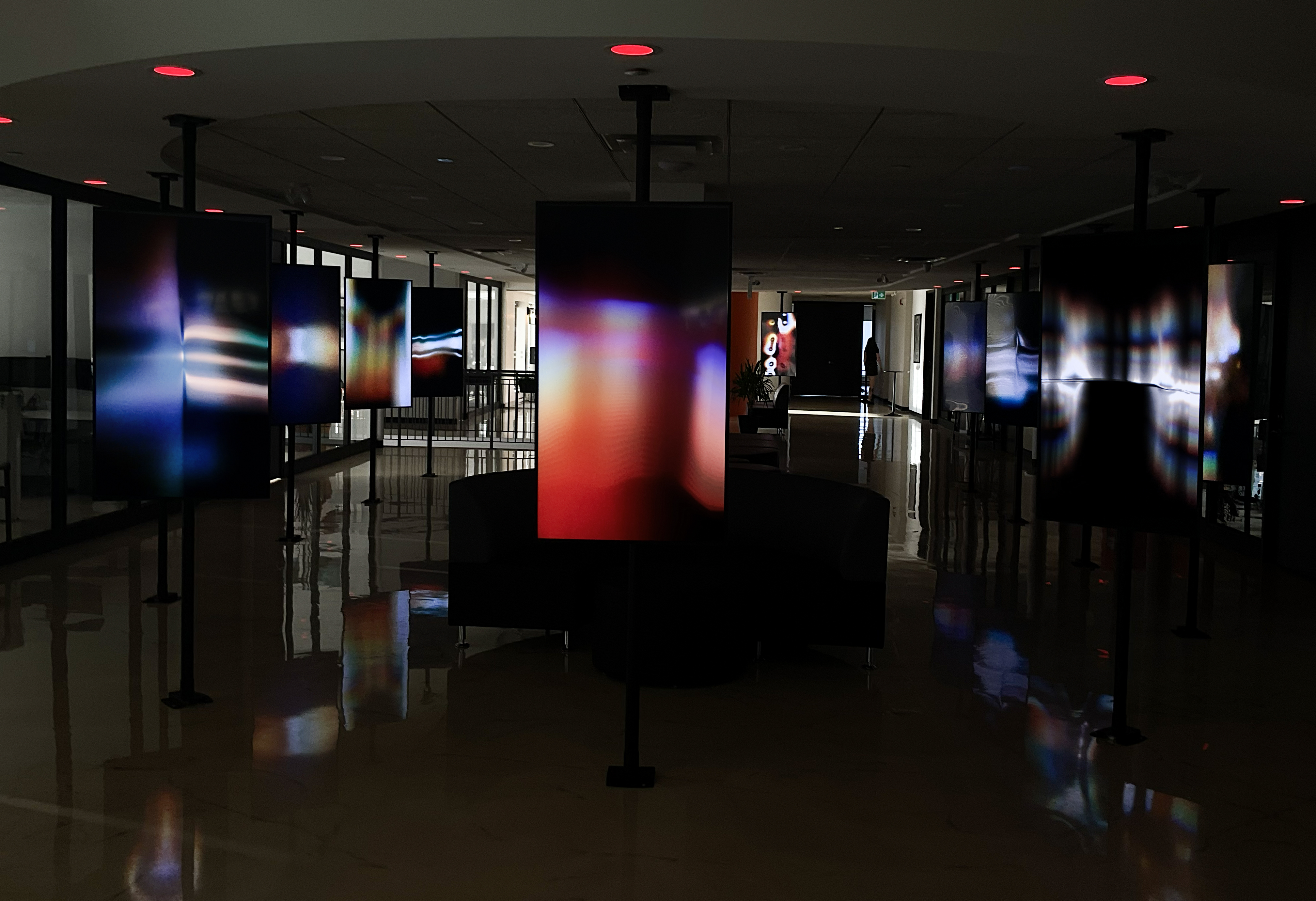
Noema will be exhibited physically at Suburbs Gallery in Montreal, and Pawel imagines the physical installation shifting how viewers encounter the series. He feels we have grown accustomed to experiencing digital images within digital environments. There is nothing wrong with that. Good UI and UX help us navigate, discover, and contextualize. But it also creates a subtle distance. We are always seeing an image inside another image. First, we enter a digital world, and only within it do we encounter the artwork. It becomes difficult to perceive it physically or spatially, to feel it next to us.
In a physical space, that dynamic changes completely. When a digital piece appears on a screen with no interface around it, no browser, no feed, no frame of reference except the room itself, it gains a kind of material presence. The screen becomes a frame. The digital image becomes a physical object.
And with that shift, a different encounter takes place. We are no longer engaging with the idea of an image but with something real, something that shares our physical space. Almost inevitably, we treat it with a different kind of attention, a slower and more serious one.
Wandering on its Own
Pawel has often said that algorithms reveal the shape of his thinking and that every decision becomes visible, and Noema grew out of an algorithm wandering on its own. When asked how this quality of digital art influenced the series, he describes a process that often felt like discovery rather than creation.
It is difficult to fully explain how this happens. He often feels that the process leads the artist as long as the artist allows it to. When you surrender to it and let certain decisions unfold intuitively, you begin to work at the threshold between conscious intention and something more instinctive. At times it feels less like creating and more like discovering. He follows a trace, and then he responds to wherever it takes him.
He is sure artists across all mediums experience something similar, but in digital art this relationship becomes a kind of dialogue with the machine. Whenever you adjust input parameters, the system gives you something back. And even if what appears is not what you expected or what you thought you were aiming for, it still becomes material for reflection, for the next step, for the next decision.
In Noema, this was especially true. The algorithm wandered on its own, generating moments and structures he could not have anticipated. Those deviations, those surprises, revealed the underlying shape of his own thinking more clearly than any deliberate plan ever could. The machine did not just execute instructions. It mirrored and expanded the logic he was working with. And in that space between intention and emergence, the series found its form.
An Unhurried Rhythm
Because Noema grew through calm, attentive development, the series carries emotional and cognitive qualities shaped by an unhurried rhythm. Pawel explains that giving each work real time helped him stay away from distractions. Some visual effects were tempting, even seductive, but they pulled the attention away from the core. Slowing down also helped him avoid a different kind of trap: becoming too impressed with his own discoveries. One of his professors used to say he stops drawing the moment he starts to like the drawing. It is difficult to do, but it prevents you from getting carried away by a new technique or a fresh idea just because it feels exciting.
There is nothing wrong with that excitement, he notes. We never lose what we have learned. But when that rush begins to overshadow the actual message, it may simply belong elsewhere.
This patience made the pieces more universal. Each image breathes a little more. It leaves room for interpretation, for personal projection, for quiet resonance. The works internalize more easily because they are not crowded by his enthusiasm. They have space to become what they need to be for the viewer.
Intention and Surprise
When asked how much of Noema comes from intention and how much from the quiet awe of encountering something the system showed him before he had words for it, Pawel responds that he would love to say everything in Noema is intentional, fully conscious, and carefully planned, but that would be a lovely fiction. As he mentioned earlier, the process often leads him. It reveals possibilities he could not predict, and his role becomes almost meditative: staying attentive, navigating between emerging paths, and interpreting what the system offers.
It is surprisingly easy to sense the moment when too much ego slips into the process. Everything suddenly becomes heavy, resistant. That is when he tends to spend long hours, sometimes days, trying to force a solution, only to finally admit that it does not belong there at all. Even that, however, is valuable. It teaches him what not to do. It sharpens intuition.
So what appears on the screen is a blend: intention, yes, but also a quiet delight in the moments when the system shows him something he did not yet have words for. Those moments are often the ones that stay.
Intensely Intimate
Many assume digital art creates distance, yet Pawel describes Noema as intensely intimate. For him, the intimacy does not come from the digital layer being hidden but from it being exposed. Every decision in a digital process leaves a trace: every adjustment, hesitation, refinement, every moment of letting the system lead. The algorithm becomes a record of how the mind moved through the work.
But the most intimate moment happens later, when the artwork meets the viewer. That is where the small private performance begins. The piece carries the imprint of his thinking, but it is incomplete until someone else stands in front of it. Their memories, associations, and subconscious intuitions begin to fill the gaps. The image shifts and becomes something uniquely theirs, yet still connected to its origin.
In that overlap between his process, the behavior of the algorithm, and the viewer's inner world, something deeply personal emerges. It is not the distance people expect from digital art. It is closer to an encounter, subtle, introspective, and sometimes surprisingly emotional.
Resonate Quietly
This idea of images evolving in the inner landscape of memory also influenced how he conceived Noema. He wanted each piece to leave space for the viewer, enough openness for someone to find something deeply personal within it. These works were never meant to become viral images or pop cultural moments. They are meant to resonate quietly but profoundly, with the specific person for whom they eventually become meaningful.
Some pieces began with heavily transformed source materials: fragments of his photographs, elements from classical artworks, or public domain images. Through the process, they were pushed to a point where they lost all recognisable detail or representational clarity. Yet when you look at them, they can still evoke memories or emotions, either ones lived personally or ones inherited through culture.
By the time these traces entered Noema, they carried a subconscious layer of meaning, a subtle narrative beneath the surface. The works were built to invite internal shifting, to become different things in different minds, and to continue changing long after the first encounter.
Subtlety and Nuance
Noema is also a debut 1 of 1 series inscribed on Bitcoin. When reflecting on how the chain shapes his perspective on permanence, memory, and the preservation of thought, Pawel describes an interesting contrast between the permanence of Bitcoin and the transience of internal experience.
If we return to the idea of the internal performance, the pieces in Noema could be seen as tickets to a show, or perhaps more accurately as matrices that each viewer can imprint in their own way. Even though the source is the same, the internal experience will always be different.
Permanence sometimes feels like an attempt to preserve existence against the flow of time. It is partly a desire for control, partly a fear of meaning slipping away. He notes that he may not look it, but he is approaching middle age, and many of his sharper ideas have softened into an appreciation for subtlety and nuance. Memory works similarly. Some impressions fade, details dissolve, yet afterimages remain, sensations, feelings, and ephemeral experiences.
He is not trying to create a monument proclaiming lofty truths. Quite the opposite. He aims to invite inner reflection, to encourage confrontation with memory, and to explore the spaces where thoughts linger. On chain, the works endure, but what truly matters is how they continue to exist within.
.png)
-1.gif)